Jim Crow system
Just MercyJim Crow system was the legalized racial segregation and suppression of basic rights that defined the American apartheid era. In the book’s account, it was not an isolated set of discriminatory customs but an institution that enforced racial subordination through law, political exclusion, and the administration of justice—and whose damage remained consequential after the Civil Rights Movement.
Historical Formation and Racial Control
After federal troops left Alabama in the 1870s, the promise of racial equality made during Reconstruction gave way quickly to renewed white supremacy. African Americans lost voting rights, while racially restrictive laws restored and enforced a hierarchy that the book connects to the effort to reproduce the racial order of slavery. Jim Crow became the legalized form of that order, more recent and recognizable than the preceding era of racial terror, but still insufficiently understood in the national memory.
Control over intimacy was one part of this system. Fears of interracial sex and marriage helped dismantle Reconstruction, sustained racial politics, and shaped anti-miscegenation statutes that prohibited relationships such as the one between Walter McMillian and Karen Kelly. The term “miscegenation” entered use in the 1860s as slavery’s supporters promoted fear of interracial relationships and the racial mixing they imagined emancipation would bring. For generations, law-enforcement officials in many Southern communities treated the investigation and punishment of Black men who had been intimate with white women as part of their role. Racial-integrity laws also served the project of restoring hierarchy and were used to justify the forced sterilization of poor and minority women.
Political and Legal Enforcement
Jim Crow’s power operated through institutions as well as statutes. In 1987, all forty elected district attorneys in Alabama were white, despite the state having sixteen majority-Black counties. As Black residents exercised voting rights in the 1970s, some prosecutors and judges worried about the electoral consequences of changing racial demographics. Legislators arranged counties to preserve white majorities in judicial circuits that included majority-Black counties. Ted Pearson, the prosecutor in Walter McMillian’s case, was more attentive to Black residents’ concerns than earlier in his career, but that attention did not produce substantive change during his tenure.
The jury remained another site of exclusion. Although the Supreme Court had ruled in the 1880s that excluding Black people from jury service was unconstitutional, all-white juries persisted for decades. Jury rolls drawn from voting lists excluded African Americans; after the Voting Rights Act, clerks and judges continued to keep jury rolls largely white through other tactics, including applying standards of supposed intelligence and uprightness to exclude Black people and women. Later decisions against underrepresentation in jury pools could bring Black people to courthouses for possible selection without guaranteeing that they would actually serve.
Discretionary peremptory strikes made that distinction decisive. The Supreme Court had prohibited racially discriminatory use of such strikes in the mid-1960s, but its demanding evidentiary standard meant that no challenge succeeded for twenty years, while prosecutors continued striking all or nearly all Black prospective jurors. In counties such as Monroe County, which was 40 percent Black, defendants could still face all-white juries, particularly in death-penalty cases. The 1986 decision in Batson v. Kentucky made challenges to discriminatory strikes more direct, offering hope to Black defendants while also prompting prosecutors to find more creative ways to exclude Black jurors.
Courtroom Space and Unequal Access
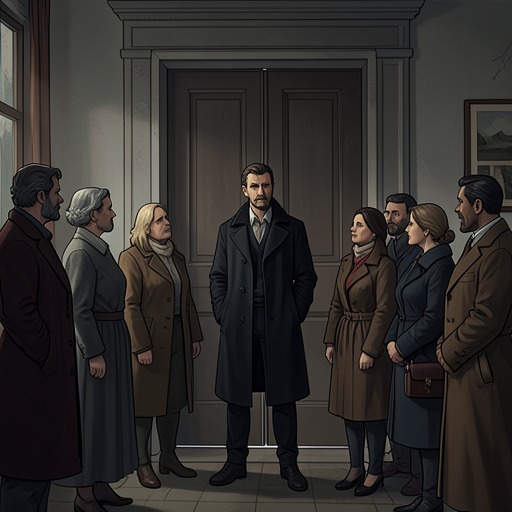
The book shows exclusion not only through formal rules but through the organization of a courtroom. At a hearing in Walter McMillian’s case, a large metal detector stood just inside the door, with a German shepherd held behind it by a police officer. The courtroom was already half full: the supporters who had filled the benches the previous day had largely been replaced by older white people supporting the Morrisons and the prosecution. Meanwhile, McMillian’s family and supporters had been told they could not enter, although the State’s supporters had been admitted. The scene made access to the courtroom itself part of the struggle over whose presence and support would be visible.
Afterlives and Historical Memory
The book distinguishes Jim Crow from the later institution of mass incarceration while arguing that the history of racial hierarchy remains necessary to understand contemporary justice. In its account, the third institution, Jim Crow, was followed in the larger historical sequence by mass incarceration; the end of formal segregation did not amount to a reckoning with the injuries caused by segregation, subordination, and marginalization. The author describes a national tendency to celebrate the achievements of the Civil Rights Movement while moving too slowly to recognize that damage or create space for people to speak about it.
That unresolved history matters in the book’s treatment of present-day criminal justice. Its opening account describes a transformation toward unprecedented punishment: the prison population rose from 300,000 in the early 1970s to 2.3 million, while the number of people on probation or parole approached six million. The book does not equate those figures with Jim Crow; rather, it places contemporary punishment within a history in which racial hierarchy shaped who could exercise rights, who could participate in legal institutions, and whose treatment the nation was willing to call just. Jim Crow’s significance lies both in the laws that enforced segregation and in the persistence of its consequences after those laws ceased to define the era.